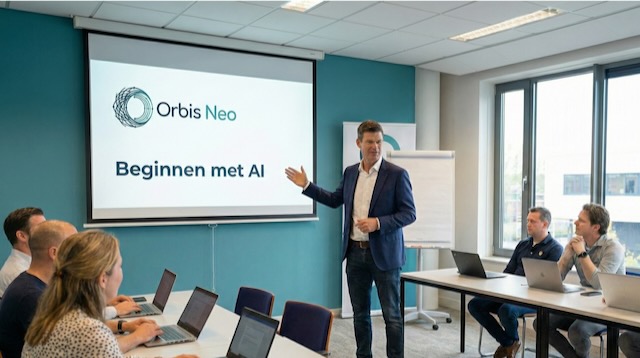
Getting Started with AI?
Do not start with tools, start with the right questions
Imagine this: your organisation invests tens of thousands of euros in AI tools. Demos are given, pilots are launched, licences are purchased. Three months later, the enthusiasm has faded. Usage is low. Impact is unclear. And the management team starts asking the first uncomfortable question: “Are we doing the right thing here?”
I am seeing this scenario more and more often. Not because AI has no value, but because organisations start in the wrong place.
AI rarely fails technically.
AI fails at the management level.
The biggest misconception when getting started with AI
Many leadership teams approach AI as a technology issue. Which tool suits us? Which vendor is “leading”? How quickly can we start? But for executives, AI is not an IT decision. It is a strategic choice that affects:
- the way work is carried out
- responsibilities and ownership
- cost structures and productivity
- risks, compliance and reputation
If you start with tools before answering these questions, you create confusion instead of acceleration.
Three reasons why AI initiatives get stuck in the management team
1. There is no shared definition of the problem
Within management teams, there are often different views of what AI is supposed to achieve. One person sees cost savings. Another sees innovation. A third sees “something we cannot afford to miss”. Without an explicit choice, AI remains a catch-all concept. And what belongs to everyone belongs to no one.
The result: isolated initiatives without coherence or priority.
2. AI is treated separately from existing processes
AI is introduced as something new, on top of the organisation. But the real value is found in existing bottlenecks: decision-making, handovers, administrative burden, reporting. If those processes are not understood first, AI becomes an extra layer of complexity.
The result: tools that are smart, but never truly land anywhere.
3. Executive ownership remains vague
AI is often “assigned” to IT, innovation or data. But decisions about work, risk and human behaviour belong in the management team. As long as ownership is not explicit, hesitation appears. Or worse: paralysis driven by fear.
The result: pilots without scaling, experiments without decisions.
What a good start with AI really requires
An effective start with AI does not begin with a tool, but with three management questions:
- Where do we, as an organisation, want to make decisions or work in a smarter, faster or more consistent way?
- Which processes are critical for this — and where do we currently see friction or waste?
- Which risks do we consciously accept, and which do we not?
These questions are not technical. They are strategic. Only once there is clarity here does responsible AI adoption become possible.
Why an AI workshop at management level works
That is why I deliberately start AI programmes with a short, focused workshop for the executive and management team. Not to demonstrate tools. But to create shared clarity.
In a session like this, we work on:
- a shared view of what AI should and should not solve
- priority processes with concrete value potential
- explicit executive ownership
- conditions around people, compliance and decision-making
The result: not an abstract AI strategy, but a clear starting point that leads to decisions.
AI is not the goal. It is a means.
For executives, the principle is simple:
AI is not an innovation project you do “on the side”. It is a lever that only works when direction, responsibility and context are right. Organise that well, and you create room for real impact.
Skip it, and you pay the learning fee.
Want to explore whether your organisation is starting in the right place?
I am happy to speak with executives and management teams who feel that AI is relevant, but have no appetite for hype or non-committal pilots.
👉 Schedule a no-obligation introduction
Together, we can determine whether your AI challenge is a technology problem, or actually a management decision.